"Knowledge for the western back roads explorer..."

Home
What We Do
What's Included
Sample Guide
Guides For Sale
Go On A Trip
Map Data
What's New
Our Services
Links
Other Stuff
Contact Us
Search
About Us


What's in a BackRoadsWest.com Virtual Guide CD?

You've already read about the overall concept of our information-packed, easy-to-use Virtual Guides in What We Do and have a good idea of what we're all about.  Now, you'd like to know more of the details.

Here, we'll tell you about:

bulletHow the Guides are divided
bulletWhat a sample Photo Tour looks like
bulletHow we use GPS for accurate directions
bulletWhy our maps are more accurate than the maps currently in your glove-box

How are the Guides divided?
Each Virtual Guide is of a particular region.  We divide this region into different chapters and then divide each chapter into different topics.  By breaking-down the information in this way, you can quickly and easily locate the exact information you're looking for.  As an example, let's use our Death Valley Virtual Guide.  Within the Guide, choose a chapter (area) that you want to know about, like Mosaic Canyon or Furnace Creek, and click on it.  Once inside the chapter, you can click on the topic that you are most interested in.

Topics*:

bullet Photo Tours
One of our specialties!  Come with us in both pictures and descriptions as we explore the Southwest.  Click here to see a small sample.
bullet Maps
One of our most unique features!  We use Topo USA and GPS to accurately locate all roads and hiking trails.  Click  3-D Topographical Profile or  Interactive View to see a sample.
bullet Hiking
Let our pictures and descriptions "virtually" take you with us as we hike the canyons and trails of the Southwest. 
bullet Road Trips
Let's go off-roading!  This section gives you descriptions and pictures of both the 4WD and lesser known roads within each Guide region.
bullet Geology
In this section, we share with you our knowledge about the geology of the area.
bullet History - the People & Places
Learn about the unique history and colorful, influential characters of each Guide region. 
bullet Photography
When applicable, we include the optimum time, place and season for photographing an area.  We also tell you when our photos were taken. 
bullet Plants and Animals
We include pictures and descriptions of the local flora and fauna as we encounter them in the wild.
bullet Lookup by Map or    Place
Want to see someplace in particular?  Click on the destination and see either the map or the home page for that area.
bullet Ratings for Hiking Trails and Roads
Every hiking trail and 4WD road is given a difficulty rating based on our personal experience.  We also include pictures whenever appropriate.
bullet References
If you want more information about a certain topic, check the reference page for books, websites and more.
bullet Glossary
Don't know what breccia, metamorphic rock or a lateral-slip fault is?  We didn't either but we do now!  Simply click on that unusual  word and read it's definition in the glossary.   

*(note:  Because each Guide is about a unique area, not all Topics will apply to every Guide.  We have, however, provided as much information as we can about every area.  To see what Topics are included in each Guide, click the Guides For Sale button and click on the Topics Included link for each Guide.)

We are, of course, very proud of our Guides as a whole but consider the Photo Tours and the Maps to be our most unique features.  So, here are small samples of each.  Click Sample Guide to see a complete Virtual Guide sample.

What do the Photo Tours look like?
They say that "a
picture is worth a thousand words" and they are so right!  How many people have visited the Grand Canyon or Zion National Park because of a picture they saw somewhere?  Each Virtual Guide contains the best pictures from our library of thousands.  You will be able to get a good "look and feel" for the area before you leave your driveway! 

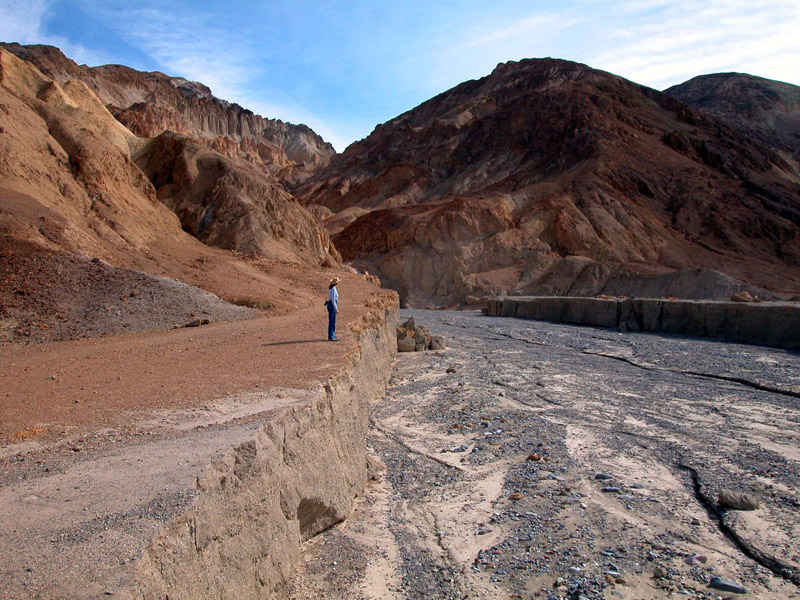
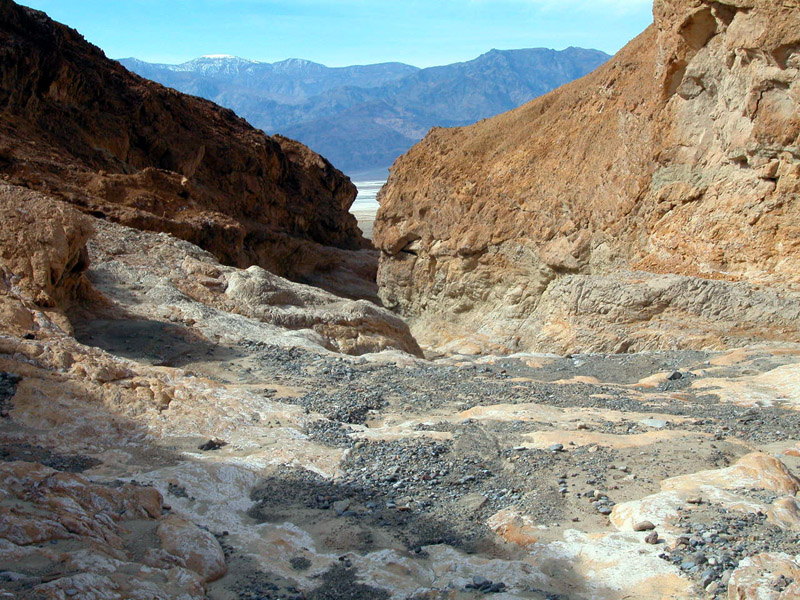
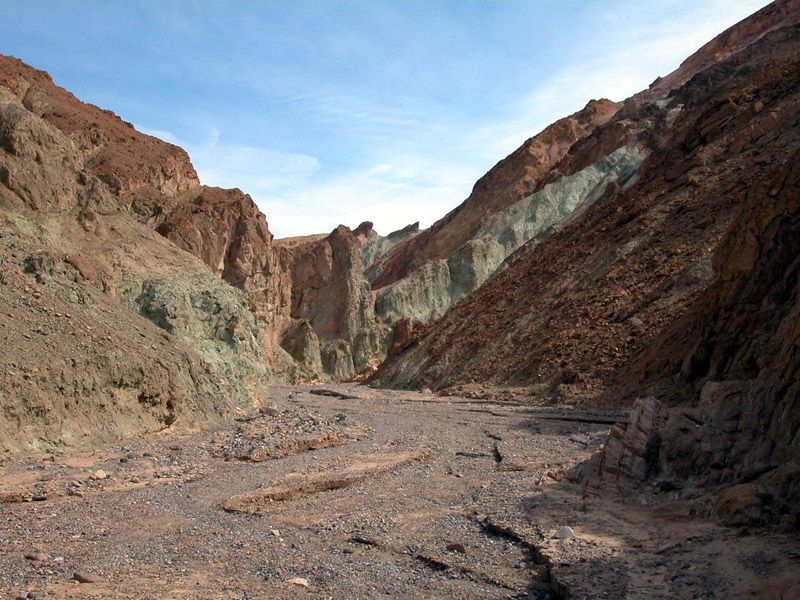
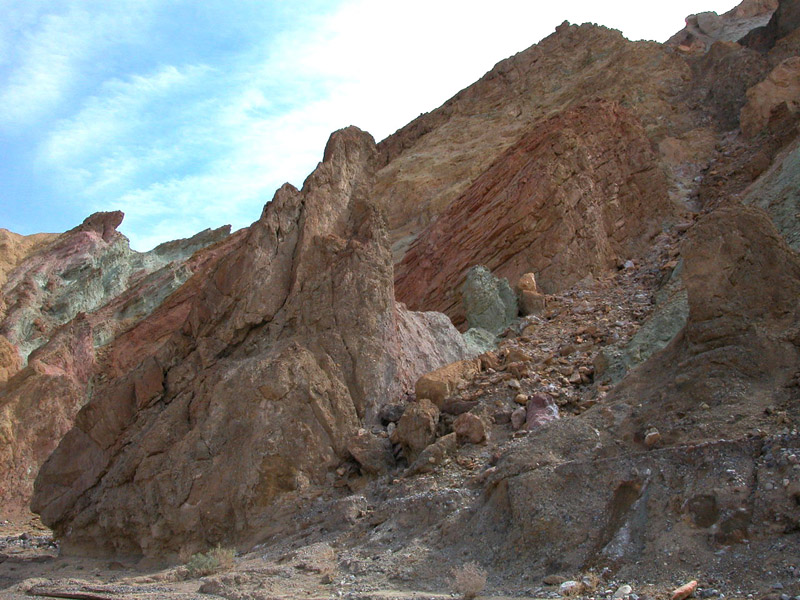
With each Photo Tour, you will be able to follow along with us as we take you, in pictures and descriptions, to our destination.  Below is a sample Hiking Photo Tour from the Gower Gulch chapter of our Death Valley Virtual Guide. Try clicking on a picture to see a larger view!

The entrance to Gower Gulch.  Because of Highway 190, Furnace Creek has been diverted into Gower Gulch.  The deep wash seen here is the result of that additional water flow. 
Just inside the entrance of Gower Gulch, looking back across Death Valley towards the Panamint Mountains.
The canyon walls have lots of colorful mineral deposits.
Another example of the richly-colored canyon walls.

Click Sample Guide to see a more complete Photo Tour.  Click here to return to Topic List.

What do the Maps look like?
Our Guides include n
ot only maps of the particular region as a whole, but detailed maps of the individual destinations within each Guide.  We also use different types of maps such as 3-D Topographic Profiles and Interactive Area View maps.

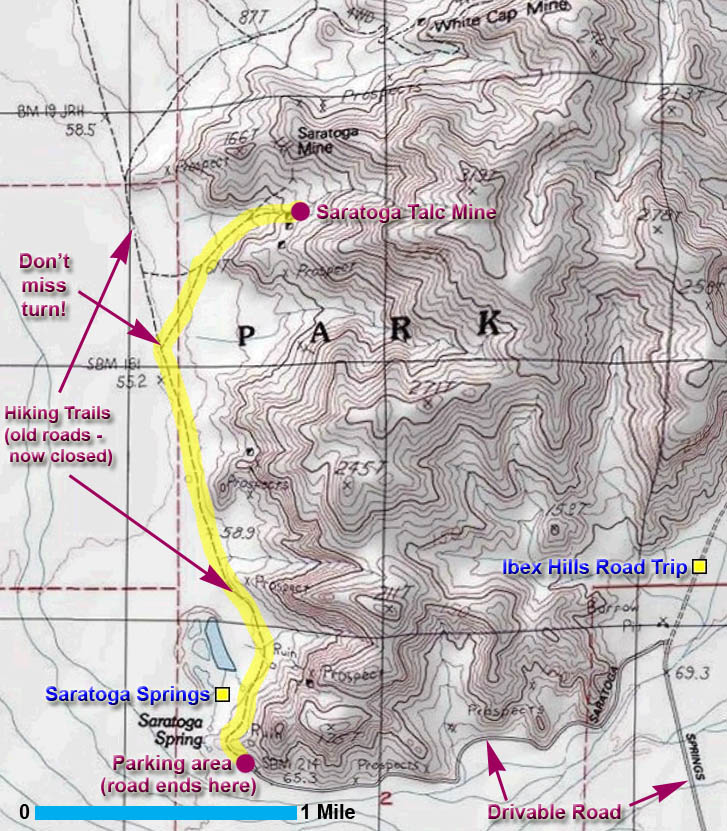
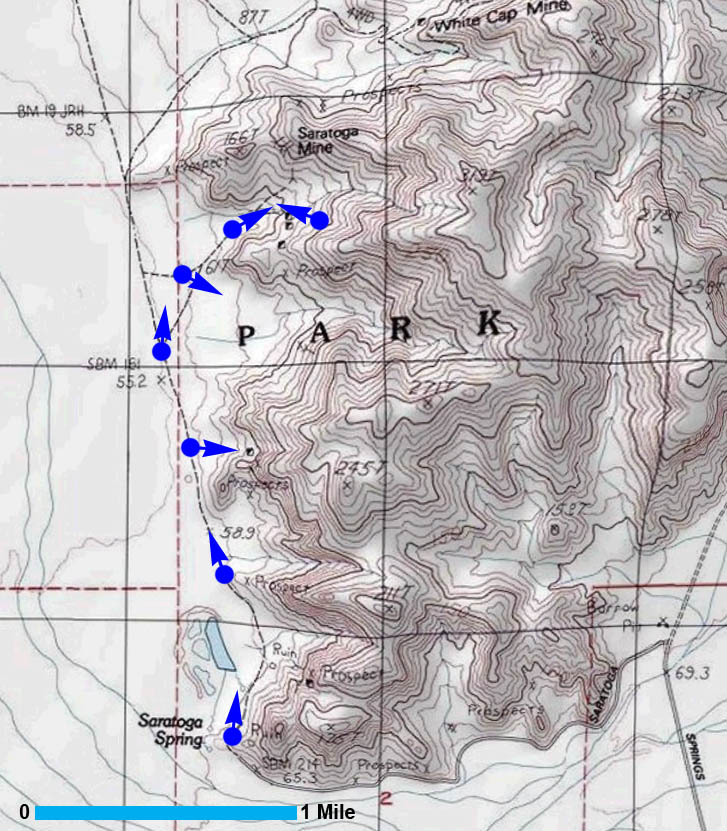
Below are samples of both types of our "specialty" maps ---

This is a 3-D Topographical Profile map from our Death Valley Virtual Guide.

To the right is an Interactive View Map from our Death Valley Virtual Guide.

With this map, you can see a photograph taken from that very spot!  We call it our "blue dot" feature.  Simply click on the blue dot.  The arrows point to the direction in which the picture was taken.

Each map has a Legend.  This one goes with the Interactive View Map to the right.  


Our Virtual Guides let you "virtually see" an area before you ever get there!  

Click Sample Guide to see more Maps.  Click here to return to What do the Maps look like?

Enhanced Map Data and Overlays
Also included in our Guides are additional map data layers that can be loaded and overlaid on top of Delorme's Topo USA software.  This allows you to see the additional information from our Guides on top of the Delorme maps.

Because the Southwest is such a large area, it is understandable that Topo USA could not possibly have the most up-to-date information on the hundreds of dirt roads that exist.  Dirt roads, by their very nature, change over the years and some do not even exist anymore.  As we explore the various regions, the GPS in our vehicle records the road's actual path.  We make notes regarding the road conditions and use "callouts" at various points along the road to indicate conditions at a particular spot.  We also use "callouts" to mark the exact location of a stop or picture taken along the way. 

Below is a sample Topo USA "base map" that shows the topography and other data.  In this example, the blue line indicates new roads that were recently built and were not on the map.  The red line indicates an area that has been filled in with mine tailings since the Topo map was published.  The "callouts" show various points of interest and road conditions.

Back to top of page

What is GPS?
GPS is an abbreviation for Global Positioning System and it's one of the most accurate ways of determining your exact location anywhere on earth.  This level of accuracy is why we don't leave home without our GPS system and why our Guides provide you with the most accurate road and trail locations available.  Maps can be outdated and roads can no longer exist but GPS is never wrong! 

Simply put, GPS works by comparing the position of the antenna (in your vehicle, for example) in relation to the 24 satellites that are in fixed orbits around the Earth.  Because these satellite positions are always known, a GPS system can calculate longitude, latitude and altitude or a three dimensional position of where the GPS antenna is in relation to the satellites (triangulation). 

We use the DeLorme GPS antenna (Earthmate - shown in picture) along with DeLorme's mapping software (Topo USA) to keep us on track, record exact locations and to create the map overlays mentioned above. If you happen to own this same system, great!  Our map overlays will work smoothly with your current system. 

Use a Sample Guide or go back to Home

Copyright © 2009, BackRoadsWest.com